
 Two scenarios often present themselves in the practice of Berard auditory integration training (AIT). One involves parents who ask if AIT might help their child who is struggling with reading. The child may read but not comprehend, or, may not be able to decode the words at all. In some cases, the child reads so slowly that all the required reading cannot be completed. The second scenario involves the parent who pursues the Berard program in hopes of reducing their child’s sound sensitivity, improving language and/or socialization, with no consideration of the impact that it may have on the child’s struggle to read. This parent may report with surprise, that their child’s reading also improved after Berard AIT. Both parents will want to understand how the Berard method, which impacts on listening skills, can affect the reading process. We need to examine certain aspects of the reading process in order to see this relationship. The National Institute of Child Health and Human Development (NICHD) along with the U.S. Department of Education’s office of Research and Improvement have been conducting studies and is one of many programs dedicated to understanding reading development and supporting research in reading for many years. Based on this cumulative work, much has been learned about how children learn to read and why some struggle with the process. Although there is still much to learn, this research provides important information that can be used to understand and help children develop proficient reading skills. It can also provide insight as to how Berard AIT affects the reading process
Phonemic Awareness
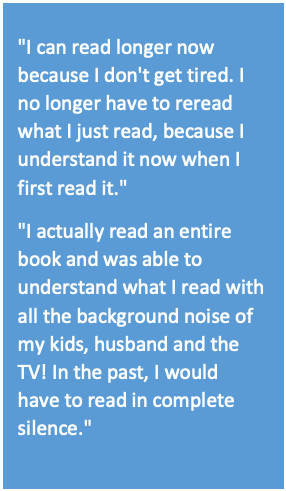
Reading requires the rapid decoding and comprehension of written words. In order to do this, children must be aware that spoken words are composed of small units of sound called phonemes. This is referred to as phoneme awareness. Phoneme awareness is not the same phonics. When phonemic awareness is evaluated, children are asked to demonstrate their knowledge of the sound structure of words without letters or written words present. (i.e. “What would be left if the /p/ sound were taken away from pit?”) Phonic skills are evaluated by determining the child’s ability to link sounds (phonemes) with letters. The development of phonics skills depends on the development of phonemic awareness. Children must be aware that spoken words are composed of small units of sound called phonemes. This is referred to as phoneme awareness. “I can read longer now because I don’t get tired. I no longer have to reread what I just read, because I understand it now when I first read it.” “I actually read an entire book and was able to understand what I read with all the background noise of my kids, husband and the TV! In the past, I would have to read in complete silence.” In order to read an alphabetic language such as English, children must know that written spellings systematically represent spoken sounds. When beginning readers can’t correctly
  perceive the spoken sounds in words, they will have difficulty sounding out or decoding unfamiliar words. For example, they must hear the /it/ sound in pit and fit and perceive that the difference is the first sound in order to decode these 2 words. This auditory perceptual problem will affect reading fluency, resulting in poor comprehension, and limiting reading enjoyment. When we listen to spoken words (i.e. bag) we do not perceive each unit of sound in the word (/b//a//g/). We perceive bag as an overlapping bundle of sound that seems to be a single unit rather than 3 distinct sounds. This facilitates the listening process and oral communication. Since the individual sounds (phonemes) within words are not consciously heard by the listener, no one receives natural practice in understanding that words are composed of smaller distinct sound units. Thus, the early stages of reading instruction must focus on phoneme awareness and phonics skills, and providing practice with these skills in text is especially critical to help struggling readers. Since readers have a limit on their attention span and memory, it is essential to develop fluency and automaticity in decoding and word recognition. When decoding is laborious and inefficient, the reader cannot remember what he has read and cannot bring meaning to the content.
Good Comprehension Requires Specific Skills
There are additional components involved in the development of good readers. Good comprehension requires the reader to link the written ideas to their own experiences and to have the necessary vocabulary to make sense of the content. Good syntactic and grammatical skills, and the ability to sequence, also impact on reading development. Given this understanding of reading development, it is easier to see how Berard AIT can impact upon this skill. The Berard method often enhances listening skills and the ability to perceive sounds more accurately. This may enable the child to perceive the spoken sounds in words so phonemic awareness can develop and phonics can be taught. Thus the basic auditory perceptual skills involved in reading may be improved through AIT. Many parents also comment on how AIT improves their child’s listening comprehension. They understand spoken language better. This improvement in listening comprehension may also extend to the ability to listen to one’s own inner language or thoughts, including the thoughts perceived through the process of reading.
Importance of Sequencing
the early stages of reading instruction must focus on phoneme awareness and phonics skills, and providing practice with these skills in text is critical The ability to sequence at many different levels impacts on reading and is affected by the Berard program. The child must be able to sequence the phonemes in words in order to sound out or decode new words. Words in sentences must be correctly sequenced in order to be meaningful and sentences within paragraphs must flow in an organized sequence. The sequence must be retained by the reader if the content is to be logical. When Berard AIT enhances the child’s ability to organize and sequence, it may help with this component of the reading process. Berard practitioners, and parents of children who have completed the Berard program, can attest to the reading progress achieved by many. The progress may be noted even during the ten days of the listening program, or it may occur more slowly, and become evident in the following weeks or months. Whether the progress is immediate or comes more slowly, it is very rewarding to see the struggling reader catch on and discover reading enjoyment.